|
|
|
Queer Music Heritage Home Page Recent Press Coverage: |
|
December 2020
Yay, quoted in an article in the New York Times! |

|
October 2020 Nice Coverage in OutSmart
|


|
July 2020 In Spectrum South
Hear
my audio
recording of this article, |
|---|


|
June 2020
|

|
May 2019 And, this nice thing happened, May 8, 2019... My
sites will be in the Library of Congress.
|


|
I also
won OutSmart Gayest & Greatest awards in 2018 and 2019 (I just didn't
scan them)
|
|
November 2017
After being
nominated for several years, I finally won the Radio award. |

|
January 2015 Article in Outsmart Magazine on the 15th Anniversary of QMH, January 2015
|

|
2014 was a pretty
good year for me. I was deeply honored to be elected Male Grand Marshal
for the Houston Pride Parade, which included riding in a convertible
near the head of the parade,
Again, I am grateful for a terrific article in Outsmart Magazine on being Grand Marshal |


|
January 2014 As I just can seem to stop adding things to my plate, in 2014 I launched two websites not related to music. One is for preserving Houston and Texas history, at HoustonLGBTHistory.org
And
the other provides obituary data on those we've lost, at And
there was a very nice
story in Outsmart about the site.
And,
one more, I am on the team for the Banner Project, a pop-up museum,
of course with its own website under my wing, at
|


|
May 2013
|

|
September 2012 Cool, another blog found me, with a review better than I could have written..:)
|

|
September 2012
I
was contacted for an interview by a blogger for the |

|
August 2012
Very
nice, I'm honored that this UK feminist blog based an entry |

|
July 2012 This
is very cool...thanks to Gerard Koskovich for letting his friends at
the Yagg article link July Show Link
|

|
March 2012
I
am much honored to have received the Allan Bérubé Prize
for 2012.
|


|
June 2010
I
was interviewed for my comments on Gay Country for an article by
|

|
Spring 2010
In the Spring
of 2010, students in a course in LGBT Studies at Rice University,
taught by Professor Brian Riedel, interviewed several members of the
Houston community. and, if they take it away, it can be found Here |

|
April 2010
To say
the least, this was VERY nice, to be voted this honor, considering I
was
Male/Gay Favorite Musician 2009: Tom Goss Female/Lesbian Favorite Musician 2009: Tret Fure Bisexual Favorite Musician 2009: John Raymond Pollard Transgendered Favorite Musician 2009: Georgie Jessup Favorite Group Award 2009: Sugarbeach 2009 Pride Song: Anna Gutmanis - "I Am Who I Am" 2009 Favorite CD / Album: 'The Pink Album (A Pop Opera)" Scott Free 2009 Camp Pride Song Award: "I Just Love Girls" Sugarbeach 2009 Dance Award: Lovari, Referenced work: "The Statement" 2009 Genre Award: Shawn Thomas, Referenced work: "Worship & Desperation" Fan Award Song of 2009: "Somethin's Comin' My Way" Dan Manjovi, "Precious" soundtrack Musical Artist of 2009: Linq Lifetime
Achievement in Music Award 2009 Production/Producer of the year, 2009: Robert Urban - "House Of Joy" |


|
February 2010
OutSmart Magazine
did a Very nice feature on me, timed to recognize |


|
January 2010
Well,
I think this is kind of cool...this French website, the Cup of Tea
for Transsexuals & Lesbians, |

|
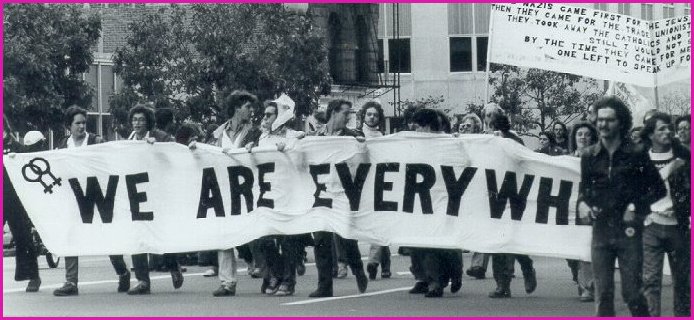
October 2008 Now, I'm a "published photographer"....sort of...:) About
a year ago I was contacted by Amin Ghaziani, who was working on a book
about the
Below, how it appears on my site.
|

|
June 2008 Wow, I'm quoted in Time Magazine!
Friday,
Jun. 20, 2008 Can a song be gay? It's a question that doesn't have an easy answer, but it's sure fun to try to puzzle out. And the True Colors tour that has been traveling across America this month would seem to be a good place to do that. The tour, founded by Cyndi Lauper last year, is highly unusual in that its main purpose, besides entertaining crowds, is to rally for gay, lesbian and transgender rights. The tour features a diverse cast of performers — including the B-52s, Tegan and Sara, the Indigo Girls, Rosie O'Donnell and Regina Spektor — onstage for nearly five hours. There's never really been this kind of organized gay-themed tour before, and its very existence, during what many urban crusaders consider a postgay era — a "whatever" age in which identity politics are on the wane — seems quaint and comforting. When the Indigo Girls hit the stage for True Colors at Radio City Music Hall recently, their set of barnstorming folk brought back warm memories of early 1990s pink-triangle-bedecked marches, a period when the movement seemed in overdrive. But is their music gay? Folk music itself is a political form and deeply entrenched in the 1970s lesbian-power movement. The Indigo Girls themselves are two gay ladies. But their songs rarely touch on gay topics. The Indigo Girls are not known for explicit anthems or same-gendered love songs. Yet so much about an Indigo Girls show is very gay. But why? Is a gay song about the orientation of the performer, as in the case of the Indigo Girls? Is it about sensibility and context, like most of the disco music of the '70s that was performed by straight artists for gay crowds? Is it about explicitly gay lyrics? J.D. Doyle, a radio DJ who hosts a Houston-based show called "Queer Voices" and keeps an archive online called Queer Music Heritage, has specific notions about what makes a song gay that are at odds with other people's conceptions. For example, he disputes the common notion that disco music is synonymous with "gay music." "I could be describing my radio show to someone who hasn't heard of it, and I'd say its purpose is to share and preserve the history of gay music," Doyle said on a show a few years ago. "They'd say, 'Oh, disco music.' No, no. And I'd climb up on my soapbox and ask why they would think disco music is gay music, since most of it is by straight artists, mostly women, and only a tiny percent is lyrically gay. Very little of it is actually about our lives. By this time their eyes are quickly glazing over, and I realize once again I've taken the purist approach. But I certainly can't deny that to most people disco or dance music is the genre most associated with gay culture." Those searching for a more fluid definition might check out a hefty tome by University of Michigan professor Nadine Hubbs called The Queer Composition of America's Sound, which purports to find gay sensibilities in instrumental music. That's right, no words, even. Anthony Tommasini, classical music critic of the New York Times, was among those who were skeptical, asking "just how is a gay sensibility expressed in music? Especially purely instrumental?" Like all the great gay
arguments, such as whether Ernie and Bert are more than just friends,
getting there is half the fun. To fuel the debate, TIME talked to people
who were both at and part of the True Colors tour to find out their
favorite gay song. |

|
January 2008
|


|
January 2008 And
the tables turn again on me, as I was interviewed for SX, a gay newsmagazine
|

|
November 2007
On November 29, 2007, I was interviewed by Dixie Treichel, one of the hosts of Fresh Fruit, the longest running Queer radio show in the country, has been on KFAI Fresh Air Radio since 1978. We talked about my website and radio work. You can download that 21 minute segment by Clicking Here. |


|
April 2007
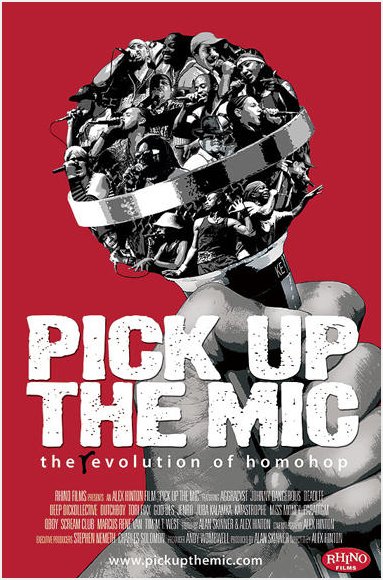
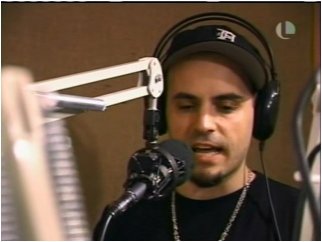
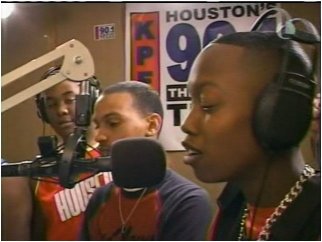
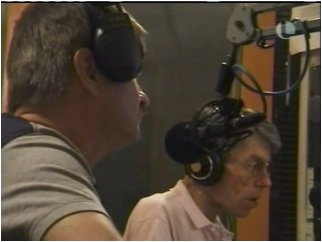
My 8 Seconds of "Fame" When the producers of "Pick Up the Mic" were trekking around the country filming the artists, they caught up with Miss Money and Dutchboy in August of 2003 when they visited Jimmy Carper's radio program After Hours, on KPFT. I was very pleased to take part of that interview, and I figured I had ended up on the cutting room floor. Well, I almost did, about 8 seconds of the side of my head survived. Jimmy fared a little better, and we both made the credits.
|




|
November 2006 (this time I'm the one being interviewed, as reported on the site eGay.com) JD Doyle - Queer
America's Own Music Historian
http://egay.com/entertainment/music/jd-doyle-queer-americas-own-music-historian.html
What was the first
song ever recorded with gay-themed lyrics? The answers in a moment. But first, a few words about the keeper of this knowledge.
J.D. Doyle is queer America’s very own music historian. A record collector all his life and a gay music specialist since the mid 90s, Doyle has amassed a library of queer tunes that comprises hundreds of titles.
Each month, he shares this music as part of a meticulously-researched radio program called “Queer Music Heritage,” heard on radio station KPFT in Houston, Texas and available in downloadable mp3 format at www.queermusicheritage.us. Along with Chris Wilson, he also hosts the “Audiofile,” a monthly review of new queer music that airs on the syndicated lgtb radio show, This Way Out. And then there’s the aforementioned web site, an image-rich romp through almost a century of queer music, featuring hundreds of photos and album covers and lists of songs about AIDS, gay marriage and Matthew Shepard.
For his efforts, Doyle has been honored with the Outmusic Award for Outstanding Support and was one of the first hundred people inducted into the GLBT/Queer Hall of Fame, organized on the internet by the Stonewall Society. His June 2004 program, “Queer Music Before Stonewall” won a National Federation of Community Broadcasting Special Merit Award.
Doyle talks about “our culture” in much the same way that people talk about “Native American culture” or “Jewish culture” – as though the queer community is an ethnic group with a distinct form of artistic expression. For Doyle the music of “our culture” is music that speaks openly about queer experience.
“Disco music is not gay music unless it’s lyrically gay,” he insists, “and that’s like 1-2% of all disco music. … I did a two-part show and exhausted everything I could find in just those two hours that was lyrically gay. And that’s terrible.”
About 90% of the songs Doyle plays on QMH are “lyrically gay.” What’s more, he packs the shows with information about the artists and frequently features interviews – often with the pioneers of queer music. All told, he figures he spends 30-40 hours preparing each show!
Doyle’s programs document the changing themes in queer music and the changing treatment of queer issues in music over the decades. Take for example his episode on homophobia in country. ”A lot of the [songs] from the 70s … were novelty songs and very stereotypical,” he says, “but this changed … and by the 90s there were a lot of songs about gender confusion – ‘is it a woman or a man’ - and a lot of the straight singers were taking a different point of view. They weren’t making fun of the person; they were making fun of themselves being in the situation. So that’s a shift.”
Doyle has also noticed an evolution in the lyrics of gay song-writers.
“It’s I want to say a little less political, because in the earlier days if you weren’t singing about coming out you were singing political songs about acceptance. Whereas yes, there’s some of that now and there’s the gay marriage songs, but I think more people are probably singing the relationship songs in a more matter of fact way. It just happens to be woman to woman, man to man.”
Still, many would say that just singing about being gay is a political act, and Doyle considers playing the music to be his own form of activism. “I want to share this,” he says. “I want to give exposure to this music [and] that just hasn’t been done.”
And now for those trivia answers:
Doyle figures
the first “out gay song” ever recorded was Ma Rainy’s
“Prove It On Me Blues” from 1928. The first nationally-distributed
album with gay lyrics was Alix Dobkin’s 1973 release Lavender Jane
Loves Women. The first “out
45” was Maxine Feldman’s “Angry Atthis” from 1969.
The first recording
by an out trans artist was a rare 45” by Christine Jorgenson, which
Doyle describes as “awful…awful.” The first artist to record a country album with out gay lyrics was Patrick Haggerty. His album Lavender Country was released in 1973. |
 Heather
is a radio producer and columnist out of Vancouver, BC
Heather
is a radio producer and columnist out of Vancouver, BC|
August 2006 Gee, now I'm a published author...:) A few months ago I was very pleased to be contacted by the editor of a special issue of the Journal of Popular Music Studies (Boston University). He asked me to contribute an article for the journal for an issue on queer popular music. My subject was "Queer Music Radio: Entertainment, Education, and Activism" Click Here to read the article.
|

|
April 27, 2006 In April myself and several radio folks with internet exposure were interviewed for an article in the Palm Springs newsmagazine "Pulp"....
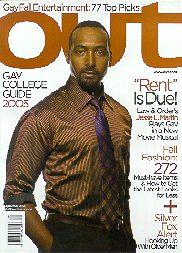
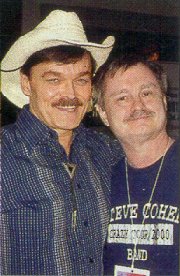
Okay, this is pretty cool....I somehow got into the Scene section of Out Magazine, in their September 2005 issue..with a pic taken of myself with Village People Cowboy Randy Jones at one of the Outmusic events in June in Chicago...gee, I'm on the same page as Janet Jackson...:)
|



|
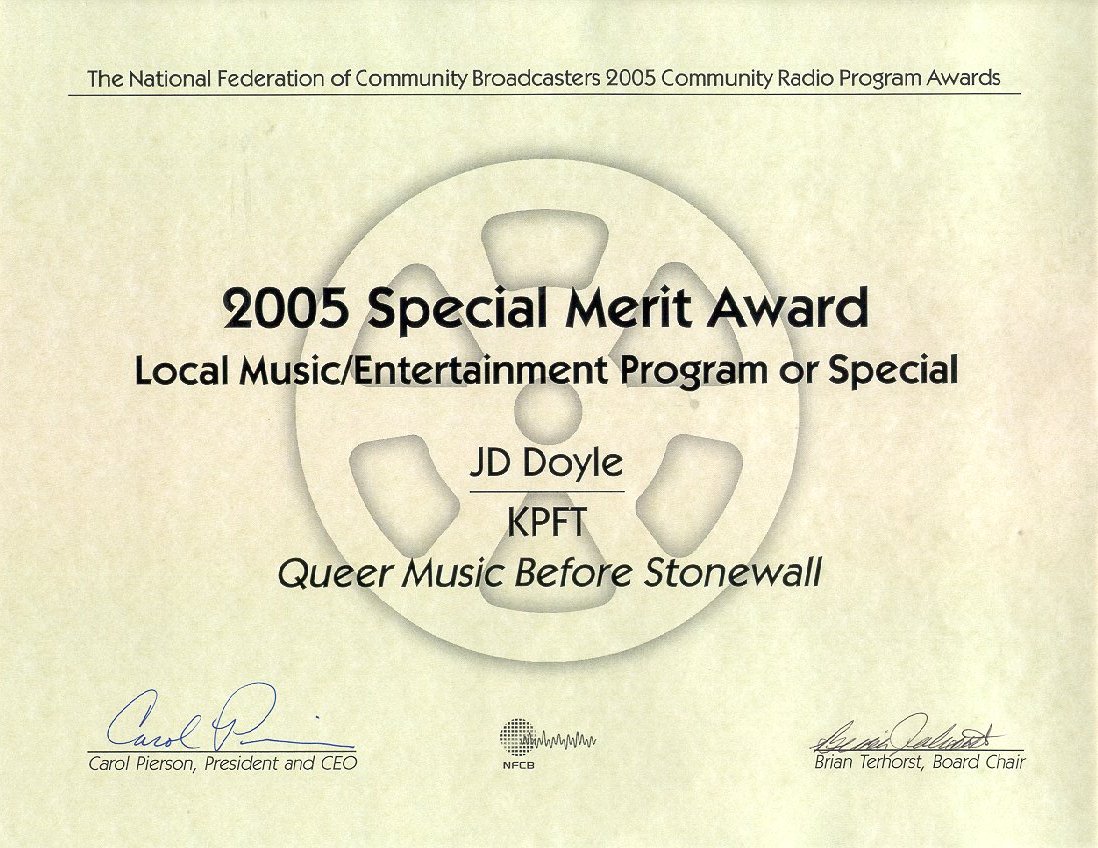
Updated April 18, 2005 National Federation of Community Broadcasting......Awards Results.... [see box below for more info] Okay, I got one of them, it's shown below So of course I trekked to Baltimore on April 15th to pick it up. Another treat was getting to meet Ginny Z Berson. She's Vice President of the NFCB, but I was more pleased to meet her because in the early 70's she was a co-founder of Olivia Records, and also a member of the lesbian political activist group, The Furies.
|

|
The National Federation of Community Broadcasters gives awards each year, in about 15 categories. Awards are open to programs broadcast on non-commercial community and/or public radio stations in the United States between November 1, 2003 – July 30, 2004. So I submitted three of my QMH shows, and my Audiofile co-producers (Chris Wilson & Christopher David Trentham) and I submitted also. My shows were up for "Local Music/Entertainment Program or Special" and the Audiofiles were in the "Arts Features and Reporting" category. Awards are given for first and second place (Golden Reels and Silver Reels) and a Special Merit Award is given in each category. Well, on February 3rd the announced the Finalists and we made it! Local Music/Entertainment Program or Special Natasha, Dedrick,
Jon Frommer, Ann Worth, and Susan Chacin of the KPFA Labor Collective:
2004 Western Workers Labor Heritage Festival. Distributed
by KPFA. Arts Features and Reporting Stacy Bond: Cracking
Down on Mash-Ups. Distributed by KQED/The California Report. According to the site, winners will be notified by the end of the month, and the Awards will be part of the Community Radio Conference, held in Baltimore April 14-16, 2005. To be among the finalists out of several hundred submissions, well, we're very pleased. We'll see... |
 Updated
February 2005
Updated
February 2005|
Spring, 2005
In 2005
Outsmart Magazine published a book commemorating their first ten years,
|

|
Recent News, as covered in OutSmart Magazine, January 2005
|

|
QMH in the press...
|
I was pleasantly surprised to open up the brand new book, "Gay & Lesbian Online," (2003) published by "The Advocate," and to find a quite glowing listing of my QMH site. In the book's Music Section it was the first radio site mentioned. And it's great to see the sites for Outvoice and Outmusic also covered, though with much less space than they deserve.
That chapter's first two pages are shown below. |




|
While they got a few details wrong... 1) My monthly QMH
spegment is a part of the ...I'm still very grateful for the coverage |


|
|
And, I suppose it's a good chance to crow about the nice mention in the nationally distributed magazine Cybersocket, in their December 2003 issue. The publication is given out free in GLBT bars and businesses across the country, and they list circulation at 70,000 copies printed. The also have an extensive website at www.cybersocket.com. |
|
and, an errata here as well: only my first six shows were half-hour in length
|
|


