back
to Drag Artist Discography entry page
Billie
McAllister

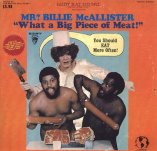
I'm
afraid the only good photo I have of Billie McAllister is from around
1968, about fifteen years
after he recorded several blues sides for a small Nashville, Tennessee
label.
From 1952, the song "31 E. Blues" comes from the 2005
compilation
"Night Train to Nashville." I know of three other tracks
from those years:
"Walking in a Daze," "I Go For That," and "Well,
Alright Baby."
In 1972 Rudy Ray Moore, known as The Dolemite, produced a very, very x-rated
comedy
album for McAllister, called "What a Big Piece of Meat,"
(Kent 101)
Texas Clippings
From The Albatross

From The Nuntius


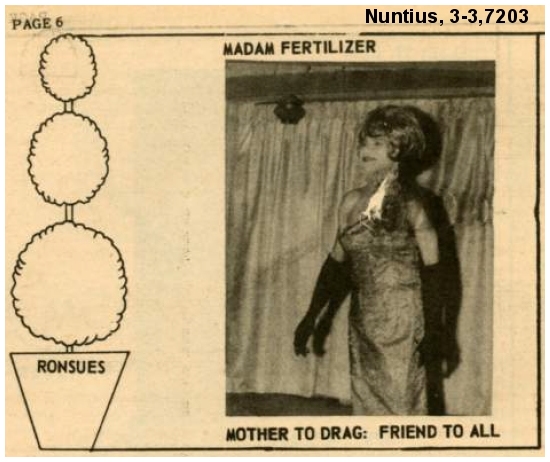
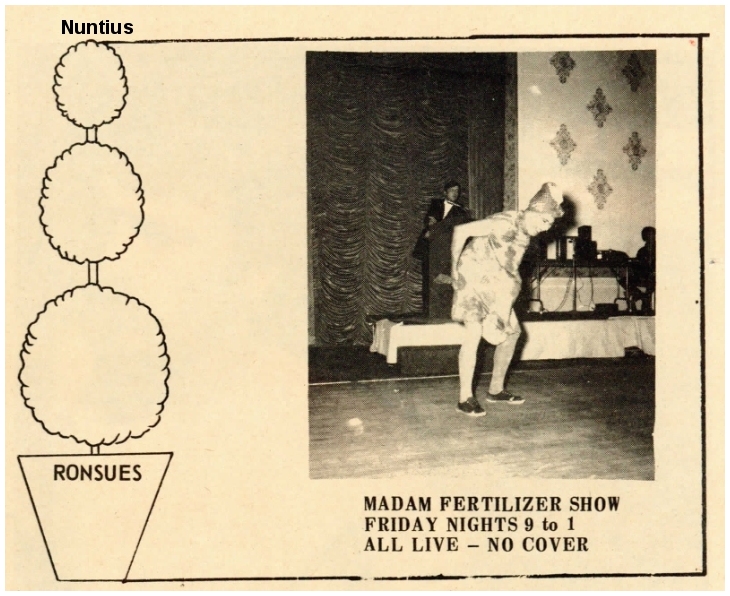
Mother of Dallas
Drag

She
died November 15, 1973
Older
Clippings
Below,
McAllister was doing drag at least as early as 1937...
Many
of these from 1937-47 were found for me by Brooks Hefner, so big Thanks.

for
the one above and below, not sure if Billie is in it but including
anyway

1938


1939
...was a busy year for her


1941


1942

1943


1944


1946

1947

1948


According
to the book above, McAllister appeared in Montreal on Nov. 5, 1948

1949


1959

Recordings
1951-1952


Blues
78's:
Tennessee
112 -- Walking in a Daze -- A
Tennessee 112 -- I Go For That (1951) -- B
Tennessee 122 -- Well Alright Baby -- C
Tennessee 122 -- 31 E Blues (1952) -- D
Tracks
available on these LPs, CDs & Downloads:
A &
B -- "Nashville R&B, Vol. 3) (Krazy Kat 7433, UK, 1989, LP)
A -- "Greatest R&B Hits of 1951, Vol. 1" (Blue Orchid,
2009, digital)
B -- "Hamhocks & Corn Bread, Vol. A" (JSP Records, 2005,
CD)
B -- "Greatest R&B Hits of 1951, Vol. 5 and Vol. 6"
(Blue Orchid, 2009, digital)
C -- "Stompin' 25" (Stompin' Records, CD)
C -- "Rare 78 RPM R&B Cuts" (Stardust, 2009, digital)
C -- "Greatest R&B Hits of 1952, Vol. 1" (Blue Orchid,
2009, digital)
C -- "Let Me Tell You About the Blues: Nashville" (digital)
C & D -- "The Best of Tennessee Records, Vol. 1, Glad Rags
to Blues" (Snailworx, 2007, digital)
D -- "Night Train to Nashville, Vol.2" (CMF Records, 2005,
CD)
D -- "Greatest R&B HIts of 1952, Vol. 5" (Blue Orchid,
2009, digital)


The "Nashville
R&B" LP has some interesting liner notes,
Click Here for those and notes
from the other CDs
Comedy
LP
1972

Downloads from this
album are now available at
http://dolemiterecords.com


And
in 2006 a CD of Rudy Ray Moore's material was reissued, containing
the first two tracks of the Billie McAllister (and also Jerry Walker)
LPs:

Below, info on McAllister from
1940 census
yes, they spell his name as Bellie, but we learn he was in
Pittsburgh 1935-39 and was born around 1915...
actually, he was born in 1911

below, I stumbled
upon a 1997 article about a headstone for McAllister,
otherwise I would have no information about his death. Rev Vincent
is below right.


Info
and images of Billie
McAllister are very rare; if you have some, please let
me know
Research Findings....

Grantmyre, Laura.
"They lived their life and they didn't bother anybody:
African American Female Impersonators and Pittsburgh's Hill District,
1920-1960."
American Quarterly, December 2011, Vol. 63, No. 4 (December 2011),
pp. 983- 1011
Laura Grantmyre
is a scholar who mentions Billie McAllister
in an article about Female Impersonators in Pittsburgh, PA.
"Like nightclubs in Harlem, Buffalo, Memphis, Washington, D.C.,
New Orleans, and Macon,
1920s and 1930s Hill District nightspots regularly featured African
American female
impersonators. Blacks' emergence at the Little Paris in the 1920s
marked the beginning.
During the 1930s, a local impersonator, Beulah, "held sway"
on the floors of Derby Dads,
the city's prime bar for interracial mingling, where, according to
the Courier writer William
Nunn, she regularly "received orchids from big downtown butter
and eggs men." When
Derby Dads closed in 1939, Beulah joined Billie McAllister, a female
impersonator from
Chicago, at the El Congo. Performing as part of the El Congo's floor
shows, Beulah and
McAllister proved popular. (This clipping is
in early clippings section, above)
A 1939 Pittsburgh Courier article titled "The El Congo Too Hot
for Mere Words" promised
its readers that "Billie McAllister, premier female impersonator,
will present a new show
titled 'Swing in Swing Time'" as part of the elite FROGS annual
social classic, Frog Week.
The Courier added that McAllister would be appearing "with the
Congo Darlings . . .
doing the fancy steps; Harry Gibbs forcing smiles through the blues,
Erlyne
Pamplin and Lucille Grace in vocals - and the great Beulah, as usual."
Further, the article included full-length photographs of five evening-gown-clad
divas
captioned with their names and specialty. Here "Beulah Mae Wong:
Female Impersonator"
and "Billie McAllister: Female Impersonator" stood alongside
"Erlyne Pamplin: Singer,"
"Wynetta Wayne: New Sensation in Song," and "Lucille
Grace: Torch Singer." By the end
of the 1930s, then, female impersonators performed at an array of
Hill nightclubs;
alongside blues singers, dance"
Notes from Laura Grantmyre
* Female Impersonators complicates
U.S. Queer History by illustrating a visibility before Stonewall (p.
983)
* Predominant female Impersonator communities were found in New York,
San Fransisco, Buffalo, Chicago, New Orleans (p. 984)
* Blues bars were known for being a space for queer and interracial
sexualities (p. 985)
* Gender impersonations in this context dates back to the late 19th
century in New Orleans concert saloons (p. 985)
* Popular female impersonators include Little Richard's alias Princess
Lavone
* Grantmyre calls these spaces for queer expression "interzones"
(p. 991)
* Billie McAllister is reported by Grantmyre as from Chicago (p. 993)
* Female impersonators often performed for Black elite (p. 993)
* Performed along Jazz bands, shake dancers, comedians, blues singers
and crooners (p. 993)
* Impersonators often became folk hero's because of their adversity
towards harassment and violence (p. 1004)
* Impersonators paved the way for Drag Queens of the 1960s
* Having older impersonators around was a form of protection for younger
Drag Queens just entering the scene in the 1960s (p. 1004)
* The effect of impersonaters on broader communities is still being
studied because most scholarship has gauged their effect on queer
communities (p. 1005)